My heart is living in Portland. The rest of me will catch up.
Back in Ashland again. Briefly.
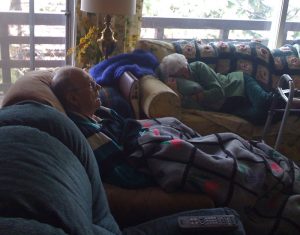
Stopped to visit the folks in Salem. Mom was asleep and I am not sure that dad recognized me. I knew that would happen. Just disconcerting. I’ll be back next weekend.
Thank you Anna and Bennett for taking care of the puppies. And Bennett for leaving me a picture of the big tree from Avatar. Really a wonder picture.
Looking ahead now. Can’t invent the unknown, want it to invite me into the future. Must invite myself into the future. Or invite the future in with less fear.
Trev and Jennifer are having little Lily at the end of May. This will be a double blessing for two really great people. A light, a beacon. We are looking forward to this event
Nicholas and Megan are going to have little Jackson in July. Jackson is already very active and I can see him keeping us all running.
I want to be in Portland for these events and to be back up as Grandma, honoring the space of my children and their children. Doing what is needed. Giving snuggles and being present in a way that I wasn’t as a working mother.
Still I need to carry on my “own” life, whatever that is now. Writing has helped pull the pieces out of my 4 year stay here while in service to Bennett and to the folks. Richard Rohr says that God doesn’t want us to get too comfortable. If that is true, I am definitely on God’s path.
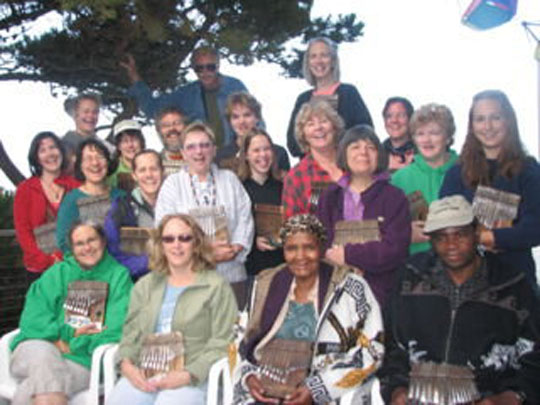
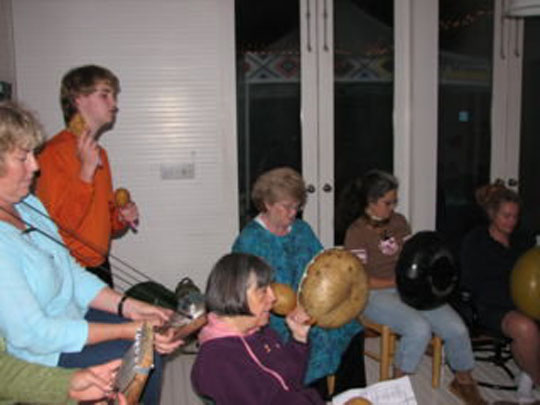
The themes, I carry with back to Portland include communication about healing, the deep music of the Shona, the fibers and weaving of spider woman, interest in academia, interest in other cultures and indigenous healing, the richness in our own culture our roots in Christianity, and family.
Family patterns are deep and rooted in our ancestors. That is something the Shona know a lot about. The mbira plays music for the ancestors. Family Constellation from Bert Hellinger offers the same idea but no 24 hour ceremony. A group forms, and the energetic of one’s family is played out by stand ins. Your parent is with you, as is your grandparent, great grandparent, siblings, cousins, etc. All part of the informing field, held in something akin to a morphogenetic field (ala Sheldrake).
This reminds me that mbira hooked me by having a similar take on the ancestors. Makes sense. Hellinger worked with the Zulu tribes and discovered the orders of love in that setting. His work has evolved out of his own Anglican priest calling and the calling to become a therapist. He can hold you as your mother while you call for her, sobbing, or be harsh to a person with a heart transplant who is feeling not himself because of the energy of the other person’s heart. Hellinger says, tough, you asked for this heart. Maybe he has softened.
Even with this powerful healing with the ancestors, the Shona are dying. Endiby, Patience’s brother, just died after a brief illness. He left 4 children and a wife. Two of the children are ill. He didn’t die of AIDS as some think, there are so many options for death in a country with a broken medical system.
This is a mystery for me to wonder what healing really is. Is dying the ultimate union with life so the work one does is from the other side.
After being a teacher and administrator and a long time conventional attempting person, I see no hope for that in my next years. Something different has called me and it started with traveling to Wupatki in Arizona, the call to form a relationship with the ancient tribes of the area to bring back that energy.
This Navajo weaving call is back to that same 4 corners area where the ancient tribes lived and the Navajo flourished even on land that is barren and dry.
The Navajo honor the ancestors and have ceremony around healing the wrongs done in ancestor time. Reichard describes this in her book, Spider Woman. She also describes how the family called her sister and she called family members in his Navajo family, mother, grandmother, sister, etc. This was true in Zimbabwe, where the people call you Ambuya (grandmother), Amai (mother), muzukuru (grandson) etc. We are all relational as a family.
Maybe this will help me break out of the “family” feeling that I am in a family of brothers who are strong. Finding my strength in my own life which has reached out in international community will be the most important next step.
I was first part of the international reiki community. I crashed an burned though I met people from all over Europe, South America, Canada, and Trinidad. And we are all pretty similar. I managed to find the very intelligent and emotionally difficult mother over and over again. Even with the work I did in family constellation. I would again and again ask, “why don’t you love me” to my mother.
Well, she isn’t going away. Spider woman is my step in feeling my own power as a human, and as a woman. A little late, but as Malidoma Some told me, better late that never.
The mbira community is really a lovely international community and I like the mix of men and women. There are still factions and opinions about what is traditional. I have a foot in several communities and choose to stand back a bit to see where I am called. Endie’s death seemed to me like an end to my connection to dzivaguru even though Patience is still alive and has been so helpful in the connection to the spirit world. Helps me to trust more what guidance comes.
What I notice still a very human trait in reiki as I felt it myself and in the mbira community of people wanting to feel that they have a special link to the source in the arena above. This seems less true in mbira where most of us will always be students. One’s mind can’t wrap around the quality of the music, it comes from a place too deep. And one doesn’t have to apologize for one’s sensitivity to the spirit that is available through the music. One can just say “yes”.
Now I am speaking of my own grappling with reiki, nothing beautiful has been called out of me in that practice, only feeling the pain of others and seeking some sort of protection from what one experiences in a treatment.
Patience, Endie, and Kelvin did a protection ceremony for me in Zimbabwe at Bushbaby. They took me out to the grass to sit and Kelvin poured water over me and (other things that I will not write of here). They prayed for protection. There is a very real understanding of what that means in the Shona culture.
In my Munay-Ki training with Licia, we always opened the protective field and would put anyone we worked on in that field as well.
There is so much more. I am surprised at what gifts writing are. Write my way back through my fear to the move to Portland.
Besides I have to tie the ribbons in Lily’s blanket. And finish the one for Jackson.
It occurs to me that turning fear to beauty is the Navajo way. Turning webs into an object of beauty with colors and patterns of our own choosing will help me with this.
A prayer from Reichard’s Spider Woman reminds me of an active way during a 9 day sing part of the prayer was:
“May happiness be mine again, I say.
The day may it be beautiful behind me,
May it be beautiful before me,
May it be beautiful above me,
May it be beautiful all around me.” pg. 167.
Beauty implies harmony to me. Beauty was a translation used by Gladys Reichard. She says that the Navajo word means many things: beauty, comfort, good luck, good health, etc.
The key is turning the feeling of fear toward action, the action of a creator, not the inaction of reclusive waiting, though both are true of my life here in Ashland. I have been both, going deeper into inaction, and more widely into active creation.
Reminded of other things that happened in Ashland as I write my way back home to Portland. Since I am just making a log of events to help feel more grounded about things I learned here, I would remember:
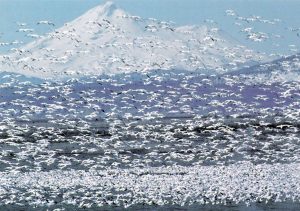
Trips to the Klamath Wildlife Preserve. Yellow headed blackbirds and bald eagles sit by the road at different times. Thousands of snow geese flock through. The Refuge is a bird watcher’s paradise.
Postcard image of snow geese
“Klamath Basin Refuges consist of a variety of habitats including freshwater marshes, open water, grassy meadows, coniferous forests, sagebrush and juniper grasslands, agricultural lands, and rocky cliffs and slopes. These habitats support diverse and abundant populations of resident and migratory wildlife with 433 species having been observed on or near the Refuges. In addition, each year the Refuges serve as a migratory stopover for about three-quarters of the Pacific Flyway waterfowl, with peak fall concentrations of over 1 million birds.” from http://www.fws.gov/klamathbasinrefuges/history.html.Rainy Tuesday. Garbage day. Recycling too.
Impressive visits. I only got lost looking for the yellow headed black bird which was on the Tule Lake part of the reserve. Dan knew where the eagles were and drove us right to them on my first excursion. He has a spotting scope and knows the ducks much better than I do.
Another field trip for me was to Mt Shasta. I made a little hike into Panther Meadow and brought my friend, Mary Ann, potable water from the headwaters of the Sacramento river. One trip led me to a crystal shop where a woman was demonstrating singing bowls. I wanted one but hadn’t planned to buy one. The demonstrator said that it was better to go work with someone than to buy a $1000 bowl. Sadly that was my last visit to Mt. Shasta. Lovely but I didn’t find what I was looking for in that lovely little town.
We revisited Lake of the Woods where we spent so very many weekends swimming in the lake. Also Fish Lake where my folks had a cabin.
Anna and I went to a couple of plays: Macbeth and Our Town. Seems like I would go every week as there are specials for towns people. Haven’t done that. Played as a musician at the Shakespeare Festival in high school and college. Good memories but it was work. I carried my bass viol around up and down between buildings and up to the music room which was on a mid floor at the festival. Not an authentic instrument of the day but Bernie Windt used what he had. He was also high school music teacher so the bass was from the high school.
Guess I am pulling from old memories and that is a different story.
Going to visit Llamas and Llambs. Kathy has a book to look at by Sarah Natani and has met a woman who has been to the Navajo reservation 5 years to weave. There is much to learn in one’s hands. Getting the facts on one’s head is easier.
The book that Kathy has includes photos and weavings by many of Sarah Natani’s students.  The photos and letters from students were gathered by Lora Pirtle Rinke and published a book called Sarah Natani.
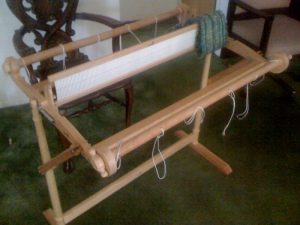
Trev, my oldest son, has said it is a go for him to build the portable loom that we will use to learn on. I found a simple one to purchase on Halcyonyarn.com if all else fails.
Nick, also my son, has applied for a URL for my blog. It will be aprilponders.com. Fitting. My father always used the term “ponder”. He always had plan 1, 2, and 3 or A, B, and plan C. Usually plan A worked.
So why did I return to Ashland for 4 years (2006-2010). I will start with what I accomplished so I remember to take something away from here.
1. (Family) Got to grow up with grandchild, Bennett who is now 5 going on 5.5.
2. (Family) Spent time and watched the incredible growth of daughter Anna who will graduate from SOU in June of 2010. Helped me grow a lot as well.
2.5 Trev and Jennifer’s wedding. Trev, my oldest son, married Jennifer Martinz. They are now in 2010, expecting a baby, Lily. We will hear much more about her when I get back to Portland. Here are Trev and Jennifer:
3. (Spinning) Took spinning classes at Websters in Ashland and Llamas and Llambs in Jacksonville.
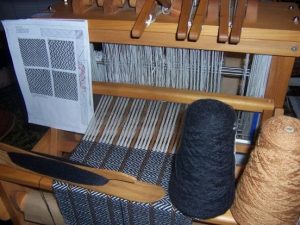
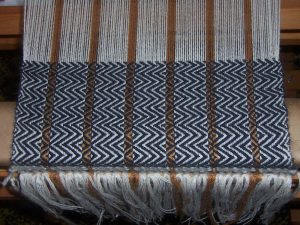
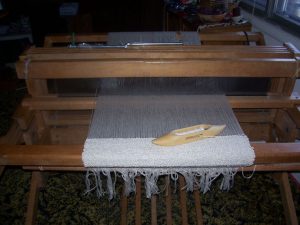
4. (Weaving) Was given a 4 shaft floor loom and bought an 8 shaft table loom. Put together the 4 shaft floor loom out of a box with Anna’s husband’s help (Sean). There were a few left over bolts. Mostly worked. The table loom is very nice.
I am reminded by my other writing that in the basement of this house, the image of Spider Woman was born. Thanks to Kevin Lewis who reminded me that on the other side of fear, lies our greatest power. Like in Batman Begins. His fear of bats, lead to Batman. Creepy in a way.
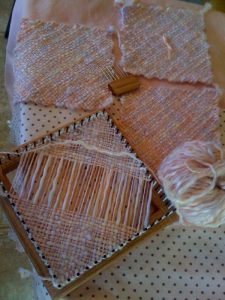
5. (Weaving) Wove small pieces on both looms plus purchased a knitters loom (rigid heddle) and wove Christmas presents one year rather remarkably. The knitter’s loom takes regular yarn and ribbon so all kinds of textures are possible with a simple weave. Took a basic class at Websters and a more advanced one there as well. Haven’t used the more advanced info (yet).
6. (Spinning) Bought a drop spindle but haven’t really used it. Now I have a Navajo spindle that is 36 inches long to begin to learn to make yarn for Navajo weaving. Reichard said that it takes several (from 4-9 years to make good yarn this way).
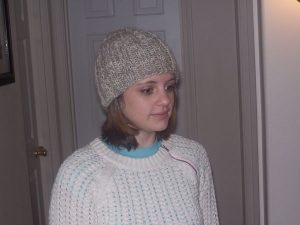
7. (Knitting) I washed, carded, spun, and knit a hat for Anna out of Romney wool that is local to the owner of Webster’s yarn store in Ashland. My mother thought I was attracting moths but I didn’t attract a single one.
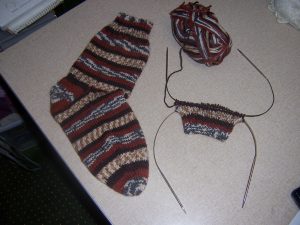
7.5 Attended my first Blacksheep Wool Gathering in Eugene. Thanks to Sally Wiley. We met there or I never would have gotten there by myself. Good intentions. The sock below is my first striping sock. I bought yarn and directions at the gathering. Reminds me to go this year.
8. (Fiber) Visited an alpaca farm by the beach and bought fiber that had been sheared into bags. The owner said that the off white fiber was out that black was in but she had few of the black alpacas. Some of the fiber was HUACAYA and some Suri. The owner suggested there would be a fiber based economy in the future. I suppose that is possible.
9. (Knitting) I processed and carded some of the dark suri with the dark romney and started knitting another hat. Haven’t completed it. Though I know where it is.
10. (Knitting) I had another round with the knitting machine and knitted and felted a hat. Talked to Zelpha about upgrading but didn’t end up doing that. Would like to make a baby sweater before I leave Ashland but probably won’t on the knitting machine. Zelpha knits for Shakespeare. She is a true artist.
11. (Navajo) Now I am coming full circle to work on Navajo weaving which has become a separate category in my blog. Love the community.
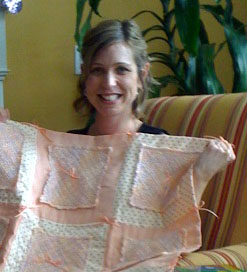
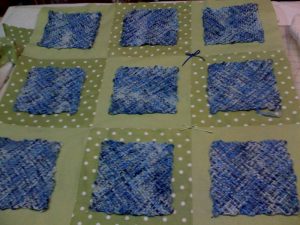
12. (Sewing) I did weave and sew a blanket this month for Lily who will be born at the end of May. I used a hand held pin loom to weave the squares. Photos to follow.
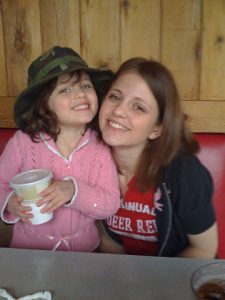
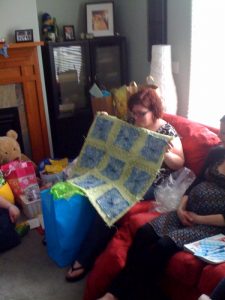
Lily’s quilt and Lily’s Mom.
12.5 Weaving and sewing a blanket for Jackson:
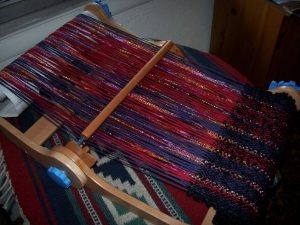
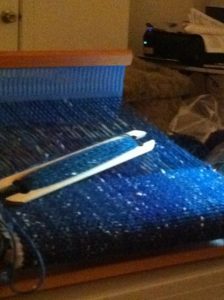
12.75 New weaving adventure with wider rigid heddle loom. 32 inch width allows for a complete baby blanket and or shawl.
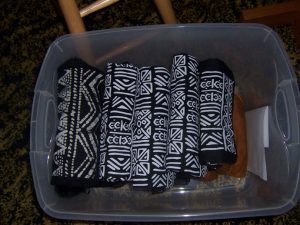
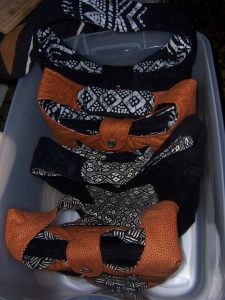
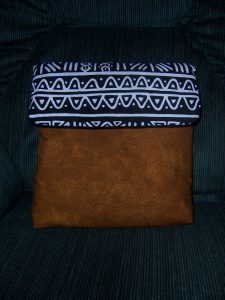
13. (Sewing) As a seque, I made mbira bags for MBIRA.org to sell at 2008 Zimfest. They sold out. I have fiber to make more. Hopefully Marilyn Mohr and I can work on some this year (2010).
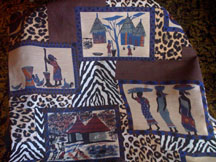
14. (Travel) I brought back fabric for bags from Zimbabwe 2009. In February 2009, I traveled (by plane and by myself) to Zimbabwe to study with mbira musicians and to visit Dzivaguru (event was organized at Bushbaby Lodge). I have a separate category in this blog for the trip which was phenomenal.
15. (Mbira) Leading up to this trip, I went to an 8 day intensive in Berkeley to learn from Patience and Jenny who traveled for the first time from Zimbabwe. I met Rosalie during this camp. Patience and Rosalie remain two of my favorite people.
16. (Mbira) Studied with Musekiwa in Eugene and Ashland and at Camp Pagungwa from Cosmas Magaya and Ambuya Dyoko. Both in 2008.
16.5 (Mbira) and Camp PaNyanza 2009 with Patience in Florence.
Camp-PaNyanza-2009
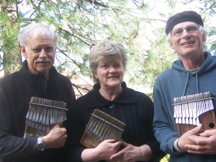
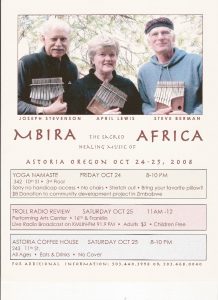
17. (Mbira) Performed two mbira benefit concerts, one for Ancient Ways in Ashland with Steve and Joseph, and one for Kutsinhira in Astoria with Joseph and Rosalie (Steve was recovering from open heart surgery.)
18. (Mbira) Playing mbira weekly with Steve so my mbira playing has been greatly improved while living in Ashland. (two trips to Berkeley for private lessons with Erica, one learning Marenje and the other Vasina Katura. both on gandanga).
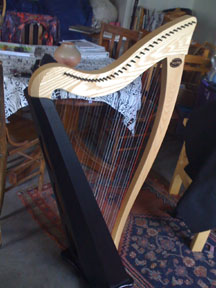
19. (Harp) Flirting with harp. Purchased nice dusty strings harp (see below). Took lessons and dan helped me add some sharpening levers. Licia, an mbira friend in Portland helped me connect with a harp sales person in Portland. When I return, I hope to continue harp lessons in some form. Hasn’t jelled for me yet.
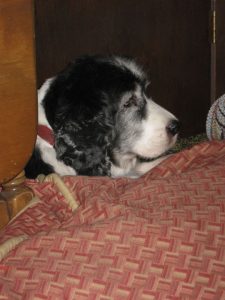
20. (Dogs) Bart passed away which was very sad as I was learning from him to live a dog’s life. Shumba and Emi are 8 months old now. A boy and a girl. Shumba loves mbira, Emi loves to snuggle. Both small miniature poodles. Well house broken. Very intelligent. Sleep on the bed with minor opinions and nosings.
21. (Family) Connected with the family tree. Have assembled all my dad’s files and my mom’s notebooks on family history. Dan had the file and sent me Family Tree Maker. Now I need to start entering where my dad left off. Not sure how much to fan out the families of husbands and wives of children and siblings. Will do what I can and add photos and info.
22. (Reading) Reading everything I can. I read a lot of junk, thrillers, but also Navajo weaving and history, Shona history, accumulated the books from the reading list of Pacifica thinking I would start on my PhD. Still plan to but when, where? Read some of Richard Rohr.. though I am not a Catholic, he speaks to me.
23. (Reiki) Visited Idaho twice. Once for a family constellation (my 5th) and once for a Master’s gathering with Paul and Susan. Gave up my membership in the Alliance waiting to see what evolves here. Interesting journey.
24. (Travel) Visited Anne-Marie in New Mexico for a week of reiki and lessons with Joy. She really helped me to get the kutsinhira in the right place on Marenje and Chipembere. Visited Anne-Marie at a Eugene camp with Patience in 2009 at Florence. We talked about the water spirit. Seems to be a link and maybe our ancestors in Alsace Lorraine.
25. (BBS TV) Watched every BBS mystery series on DVD from DJ’s video. Just found a new series on Netflix, Waking the Dead but it hasn’t all been converted to US format and probably won’t be.
26. (Family) Watched as my folks continued a downhill spiral into different forms of dementia. Dad fell in 2009 and broke his hip. Hasn’t really been the same since and we had to have a 24 hour care person here to bring him home over a year ago. This was the most difficult part of the stay here. Hard to really grasp the difficulties that they have faced and how tired I became towards the time for me to go back to Portland. We have moved them to Salem where Tim is overseeing their care. Bless you Tim. So this is only the beginning. Lots has happened since I have been here. I just wanted to remember all of it. I will add some pictures when I can. Came for Bennett and Anna and I learned a life time of lessons while here.
Woke up thinking about Navajo Weaving. On the breakfast table I had laid out the book, The Navajo Weaving Tradition: 1650 to the Present. I started leafing through the book looking for blue dyes. Indigo seemed to be the most prevalent blue– set with fermented urine as not a mordant (or fixative) but a “strong alkaline solution as a carrier”, p. 134. Used until the late 19th century.
The study now begins for me of what blue is now used and what blue will emerge in my studies with Sarah Natani. Using natural fiber and natural dye seems very important in creating a carpet from the earth. I want an earth carpet. Something that integrates the elemental earth, all aspects.
The Navajo have the beauty way, the way to harmony. This step seems important in weaving to hold this feeling of harmony as I approach this study.
Earthues in Seattle uses natural dyes. Combined with my study with Sarah Natani, I want to travel to Seattle to study with Michele Wipplinger who teaches wonderful classes on natural dye. My long time friend and carpet lover, Joyce, has shown me the samples that she brought back from a class, really lovely. We share the love of a good natural fiber either hand tied or woven into a carpet.
I digress. This morning I received an e-mail from Patience who is a wonderful friend and mbira teacher from Zimbabwe. I was reminded of the water spirit that I had met in my travels to Zimbabwe to the mountains village of Dzivaguru where the spirit mediums live. I wondered what this carpet weaving on the Navajo reservation could mean. Why was I being called to weave in a tradition that had so little water, no wide expanses of blue. This was my reason for looking for blues in the Navajo carpet and for any small sense of elemental water.
The Shona have no “spider woman” lore. Though the spiders are huge in Zimbabwe. I need a spider woman in my life, a grandmother spider woman, creator and holder of a power that is grounded and harmonious. This fearful image also brings life. In a Jungian sense, is allows the shadow a place in one’s home.
I want to weave a carpet with the image of spider woman. This might take some time. Looks simple but first there is much practice of stripes and zig zags. Vertical lines, horizontal lines, diagonal lines, all must be practiced.
Somehow there seems to be time to think of practicing. I who have been up against time, seeing that it no longer feels unlimited and looking for ways to take my patterns into the world of spirit where they might remain at least in traces of memories after death.
What survives? I watch my parents lose touch with all the things they thought to be important except family, a bit, and glimpses of greater love. Who are they now? What is the function of these later years that flirt with death even with a cosmology that embraces death, what part of that cosmology has failed my parents, and has been failing me now.
My search is for that peace, to allow beauty. To sit with people who allow beauty in simplicity, survivors of a harsh white world.
How can a bit of wool and a simple loom be the gateway to another world, the world where spider woman awakes. More on that thought to follow.
After many encounters with spiders in my temporary housing in Ashland, Oregon, a brother, Kevin, suggested that I look at my fear as a source of power. My interest in weaving and love of the Southwest combined in my search for the seat of Spider Woman’s power.
Over the last 4 years, the interest in Navajo weaving has come up again and again. Two years ago I tried to enroll in Sarah Natani’s weaving course at Table Mesa, New Mexico. The course was filled. Meanwhile, I met Kathy at Llamas and Llambs in Jacksonville, Oregon.
Kathy recommended two books, Spider Woman: A Story of Navajo Weavers and Chanters by Gladys A. Reichard and Navajo Weaving Way: The Path from Fleece to Rug by Noel Bennett and Tiana Bighorse. I purchased Navajo Weaving Way as it was readily available. Also the video set, Navajo Weaving: Sharing the Technique and Tradition by Angie Walker Maloney (assisted by Susanne Clark) which I found at Webster’s Yarn in Ashland, Oregon.
A friend gave me a loom and when I went to pick it up where it was stored, I was fortunate to met, Audrey Moore who helped found the Damascus Pioneer School which is now Damascus Fiber Arts School. Her weaving which included the spider woman image, inspired me.
When considering my move back to Portland, I thought surely I would go straight to the Damascus Fiber Arts center to register for a class. Surely this will happen, meanwhile, while visiting Llamas and Llambs, Kathy mentioned that she had had a visitor who had information about a class being organized in Carlton, Oregon featuring Sarah Natani. Kathy had some serendipitous events going on herself as her original Navajo Weaving teacher had just come through the store.
Kathy sent me the email of information for the Carlton class organized by Lora Pirtle Rinke. Lora answered immediately through facebook that there was indeed room in the class in Carlton.
Meanwhile, I contacted Kathy Burnham who was organizing the class with Sarah Natani on the reservation and she said, “yes there is room”.
So in the course of two days, I had signed up for two classes. Lora had posted that it would be possible to get hand carved forks and battens from Al Snipes. He responded to my e-mail that he didn’t do retail but would make a batten as part of a batch he was sending out and mail it to me. He followed up with a phone call.
At this moment, I was charmed by the community surrounding Navajo Weaving. This kind of care in providing a weaving tool seemed way out of the ordinary. I have since received my batten that has a smooth, pleasing touch. Beautifully crafted.
Over lunch, I read Spider Woman a bit a day, having now finished the book, I marvel at the intelligence and unique quality of the writing of Gladys A. Reichard. I had previously read her book, Navajo Religion. This book provided my first glimpse into the complexities of the Navajo way of life, a complexity and commitment to cosmology that Ms. Reichard suggested lead to the survival and flourishing of the Navajo as a people. Impressive. Intriguing.
Cosmology was a challenge question presented to a small group of practicing masters of the Usui System of Natural healing. The question was, do you have to know your cosmology? Is it important. Yes, it seems that it is.
Without digressing, that question has lead me to this moment. Where lies Spider Woman in my cosmology and what is it that I need to know here?
Bennett, Noel and Tiana Bighorse. Navajo Weaving Way: The Path from Fleece to Rug. Interweave Press: Loveland, 1997. (Three books combined formerly: Working with the Wool: How to Weave a Navajo Rug, Designing with the Wool, and The Weaver’s Pathway all by Noel Bennett with additions and revisions).
Dedera, Don. Navajo Rugs: How to find, Evaluate, Buy and Care for Them. Rev. Ed. Northland Publishing: Flagstaff, 1975.
Jongeward, David. Weaver of Worlds: From Navajo Apprenticeship to Sacred Geometry and Dreams, a Woman’s Journey in Tapestry. Â Destiny Books: Â Rochester, 1990.
Kaufman, Alice and Christopher Selser. The Navajo Weaving Tradition: 1650 to the Present. Counsel Oaks Books: Tulsa/San Francisco, 1985.
Kent, Kate Peck. The Story of Navaho Weaving. McGrew Printing: Phoenix, 1961.
McQuiston, Don and Debra. The Woven Spirit of the Southwest. Â Chronicle Books: San Francisco, 1995.`
Maloney, Angie Walker. Navajo Weaving: Sharing the Technique & Tradition. Yarn Barn: Â Lawrence KS, 1998. (2 videos).
Reichard, Gladys A. Spider Woman: A Story of Navajo Weavers and Chanters. University of New Mexico Press: Albuquerque, 1934.
Reichard, Gladys A. Weaving a Navajo Blanket. Dover: New York, 1974. (originally Navajo Shepherd and Weaver. J.J. Augustine: New York, 1936.)
Spurgeon, Caroline M. Weaving the Navajo Way: How to Create Rugs, Miniatures, and More! Caroline M. Spurgeon: 2008.